
Bench Warrants in Limestone County
A bench warrant is court-directed arrest process often tied to a missed appearance or another unmet court duty. In Limestone County, the first task is to identify the court that set the case. A traffic ticket may be with JP1 through JP4 or one of five municipal courts; a county misdemeanor and a felony use different court and clerk routes.
A missed date does not establish by itself that a warrant was issued. Chapter 45A includes notice and voluntary-appearance rules for JP and municipal cases, and the court's action depends on the case history. Ask whether the docket shows a new setting, capias, capias pro fine, or other process.
Limestone County JP Courts Route FTAs
The four Justice of the Peace courts handle Class C and traffic matters within their precincts. Each keeps its own case files, so a JP2 citation should not be routed to the JP3 payment service just because both are county offices. The official JP directory lists precinct contacts and payment links.
Use the precinct printed on the citation. JP1's current officials listing is blank, so call its office and confirm the current assignment before travel. For a city ordinance case, use the city court named on the paper instead of the JP directory.
The county directory image shows the four precinct route. Confirm current contacts against the July 2026 county officials source.
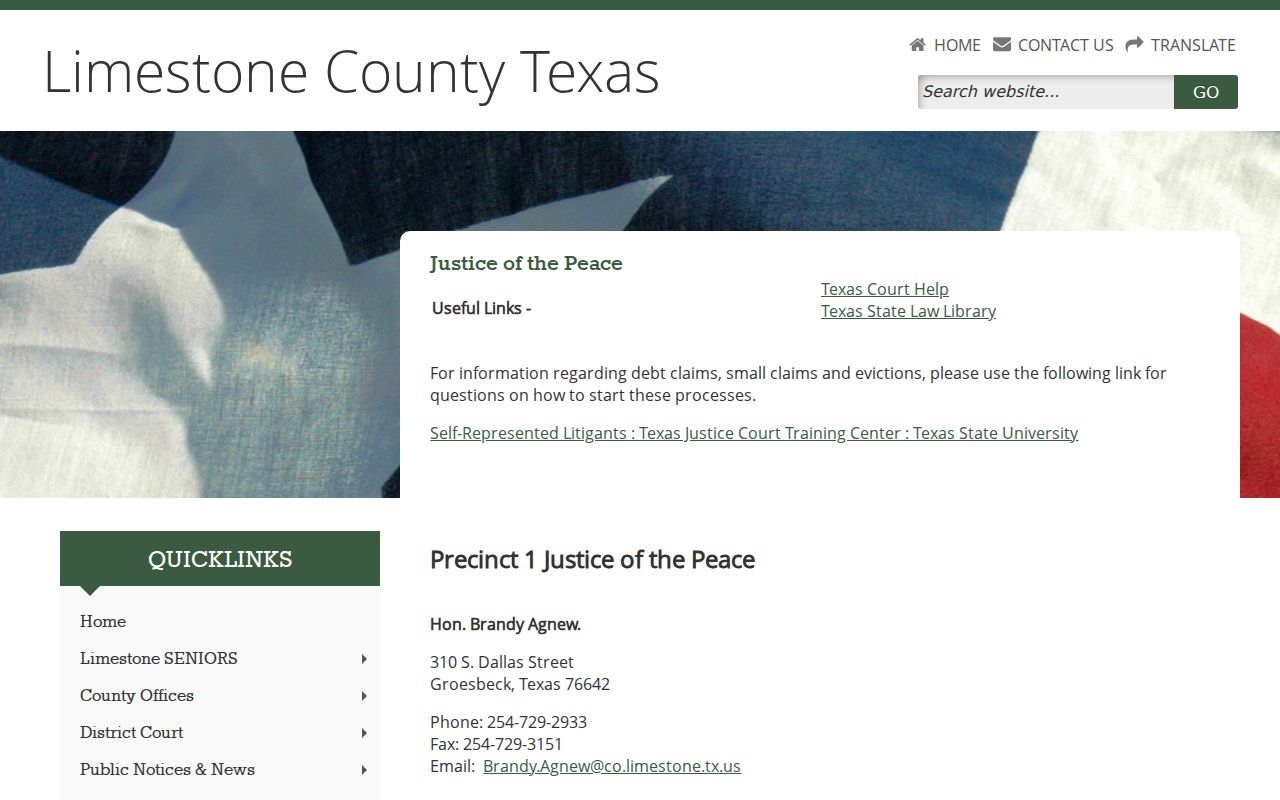
The directory maps court contacts; it is not a warrant roster or a status result.
How a Limestone County Bench Warrant Is Issued
The court sets the appearance or payment duty, reviews the notice and case history, then determines what process applies. A JP or municipal judge can issue lower-court process within the court's authority. A county or district case follows that court's procedure. The sheriff, constable, or city police may serve an order, but does not decide whether the issuing judge should recall it.
There is no single public Limestone warrant system that collects every court's status. A court entry may be private, sealed, or limited to its own docket. Ask that clerk whether process was issued and whether a separate service agency has received any later court order.
Limestone County FTA Does Not Mean Automatic Process
Read the notice and appearance date, then call before the date if attendance or payment is not possible. Chapter 45A sets lower-court procedures for failure to appear and voluntary appearance. It does not support a blanket statement that every missed setting creates an arrest warrant at once.
Ask whether the court recorded an FTA, sent notice, reset the case, or issued a capias. If the clerk cannot answer a legal question, ask about forms and calendar steps, then speak with a lawyer about strategy. Court staff can explain process logistics, not represent the person.
Bench Warrant vs Arrest Warrant
Both can authorize an arrest, but the reason and case posture differ. A bench warrant or capias follows a court obligation; an arrest warrant begins with the Chapter 15 complaint, affidavit, and probable-cause review. Neither label proves guilt. Ask the issuing court for the process type and current status.
| Feature | Bench Warrant | Arrest Warrant |
|---|---|---|
| Trigger | Missed appearance or another court duty, as determined by the court. | Complaint and legal probable-cause review. |
| Who Issues It | Judge of the court handling the existing case. | Authorized judge or magistrate. |
| Underlying Case | Existing citation or case with a court obligation. | Criminal accusation and related process. |
| How It Changes | Ask the issuing court about appearance, recall, or quash order. | Ask counsel and the issuing court about bond and next setting. |
Limestone County Bench Warrants and Capias
“Bench warrant” is often used in plain speech, while lower-court paperwork may use capias language. A capias pro fine is tied to an unsatisfied fine judgment and has its own Chapter 45A steps. It is not interchangeable with a new arrest warrant or with the amount of a bond.
- FTA
- Failure to appear for a required court setting.
- Capias
- Process directing an officer to bring a person before court.
- Capias pro fine
- Process connected to an unsatisfied fine judgment.
- Recall or quash
- A court action withdrawing or setting aside process.
How to Resolve a Bench Warrant
Call the issuing clerk and ask whether the case is delinquent, whether process was signed, what court appearance is required, and what record will show a recall. The correct steps vary. A city case may allow a plea form or court-approved payment; another case may require an appearance, a bond decision, or counsel's motion.
- Confirm the court and case number from the citation or docket.
- Ask whether a voluntary appearance, reset, plea, payment plan, or hardship process is available.
- For a serious charge or unclear bond status, ask an attorney to review the process and appearance plan.
- Save the court order or receipt and ask when the serving agency will receive the update.
Caution: Do not assume a missed date created a warrant or that payment removed one; confirm both facts with the issuing court.
Limestone County FTA Fees Are Not Bond
The October 2025 OCA justice-court cost chart describes a $75 officer execution or process fee for qualifying warrants and capias, effective January 1, 2026 for offenses committed on or after September 1, 2025. Older matters may use another offense-date amount. This is a court-cost component, not bail and not a universal “clearance price.”
Ask for a case-specific breakdown of fine, court cost, vendor or collection charge, process fee, and bond. The sheriff's pages do not publish a countywide bond schedule or a walk-in surrender window. Call before travel and ask the court what can be handled by mail or at a setting.
Review the OCA chart with the issuing court's current instructions.
Which Limestone County Court Issued It
The court listed on the citation or case paper owns the hearing and recall path. Municipal tickets stay with their city court; JP citations stay with the precinct on the ticket. County misdemeanors route through County Court and County Clerk, while felony files go through the assigned district court and District Clerk.
The sheriff may serve process or answer custody questions, but it cannot replace the court's decision to recall it. If a case number is missing, ask the likely clerk whether it can route the inquiry and what private identifiers it needs. Start with the JP directory for precinct contacts.
Limestone County Bench Warrant Records Need Follow-Up
Keep the filing date, name of the office contacted, amount quoted, and any form or payment receipt in a private file. If the court says the matter is clear, ask whether the answer refers to the court docket, the service return, or both. Those systems may not update at the same moment.
For an authorized relative, ask whether the clerk needs written permission before sharing case details. Juvenile, sealed, family, and active-investigation information may be restricted. Do not seek a public roster; use the process only to understand and resolve the person's own case.